Advanced Database Management

- Description
- Curriculum
- Reviews
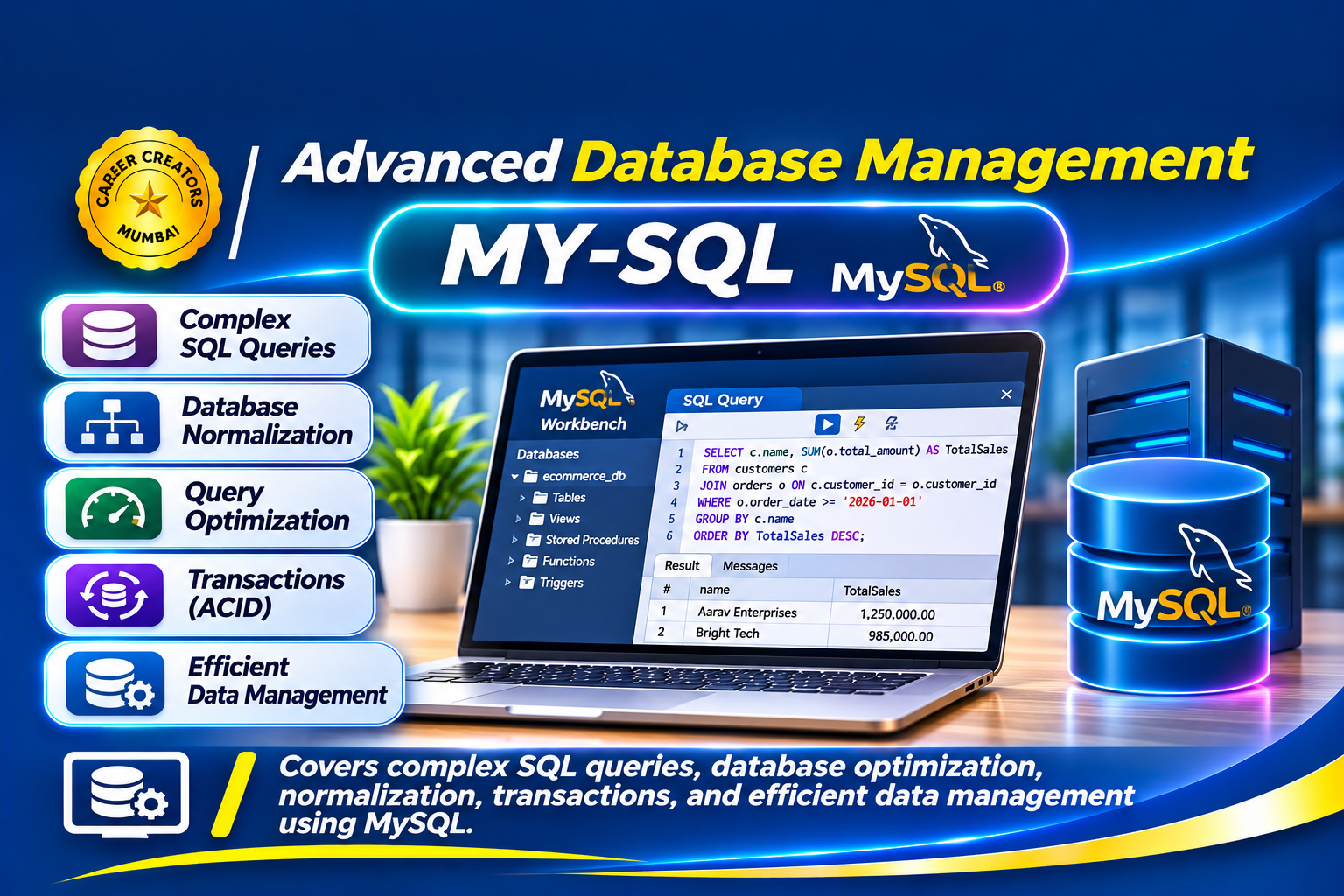
The Advanced Database Management course is designed to develop professional database management and SQL programming skills using MySQL.
Modern organizations depend on databases to store and process large amounts of information. Managing these databases requires knowledge of advanced SQL queries, database design, normalization, transactions and optimization techniques.
This course provides practical training in MySQL and teaches students how to work with structured databases, perform complex queries and manage information efficiently.
Course Modules
1. Introduction to MySQL
-
Understanding MySQL database management systems.
-
Installing and configuring MySQL.
-
Understanding databases and tables.
-
Creating and managing databases.
-
Working with MySQL environments.
2. Advanced SQL Queries
-
SELECT statements.
-
WHERE conditions.
-
ORDER BY and GROUP BY.
-
HAVING clause.
-
Aggregate functions.
-
DISTINCT and LIMIT.
-
Combining multiple conditions.
-
Advanced filtering and sorting.
3. Joins & Subqueries
-
Understanding database joins.
-
INNER JOIN.
-
LEFT JOIN and RIGHT JOIN.
-
CROSS JOIN fundamentals.
-
Self joins.
-
Subqueries.
-
Nested queries.
-
Working with multiple related tables.
4. Database Design & Normalization
-
Understanding database design.
-
Functional dependencies.
-
First Normal Form (1NF).
-
Second Normal Form (2NF).
-
Third Normal Form (3NF).
-
Reducing data duplication.
-
Improving database structure.
5. Transactions & Data Integrity
-
Understanding database transactions.
-
COMMIT and ROLLBACK.
-
Transaction management.
-
Constraints and data validation.
-
Maintaining data consistency.
-
Understanding ACID properties.
6. Database Optimization & Management
-
Understanding database performance.
-
Introduction to indexes.
-
Query optimization fundamentals.
-
Database backup and restoration.
-
Managing database users.
-
Access permissions and security fundamentals.
7. Practical MySQL Projects
-
Employee Management Database.
-
Inventory Management Database.
-
Sales Management Database.
-
Customer Information Database.
-
Order Management Database.
Learning Outcomes
By the end of this course, students will be able to create and manage MySQL databases, write complex SQL queries, work with multiple related tables and understand database normalization and transactions.
They will also develop an understanding of database optimization and efficient information management, preparing them for further learning in backend development and database administration.
Course Category: Advanced Database Management & SQL Programming
Software Covered:
-
MySQL
-
MySQL Workbench (where used)
-
SQL
Skills You Will Develop:
-
Advanced SQL programming
-
Complex query writing
-
Joins and subqueries
-
Database normalization
-
Transaction management
-
Indexing fundamentals
-
Query optimization
-
Database backup and security
Practical Projects:
-
Employee Management Database
-
Inventory Management Database
-
Sales Management Database
-
Customer Management Database
-
Order Management Database
Suitable For: Students with basic database knowledge, IT learners, aspiring SQL developers, database administrators and individuals interested in backend development.
Prerequisites: Basic database concepts and introductory SQL knowledge are recommended.